
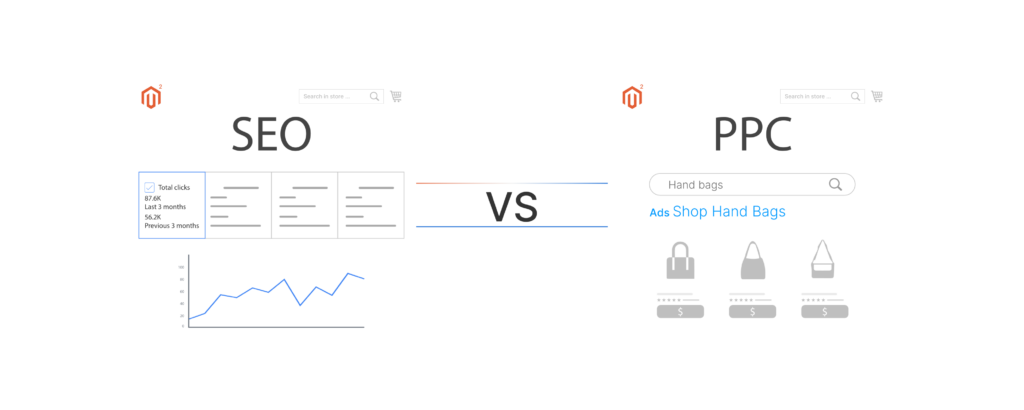
The e-commerce landscape is more competitive than ever, especially for businesses utilizing robust platforms like Magento. As a merchant, the ultimate goal is to drive consistent, high-quality traffic that converts into revenue. However, the path to achieving those sales often leads to a fundamental debate: Magento SEO vs PPC. Both strategies offer unique advantages and come with distinct costs, but choosing the right one—or finding the perfect balance—is critical for long-term profitability.
Understanding the trade-offs helps store owners answer vital questions: Should I invest in a long-term foundation that reduces customer acquisition costs over time? Or do I need immediate sales to clear inventory and fuel cash flow? This comparison explores how each channel influences the buyer’s journey and which strategy ultimately drives more sustainable sales for your specific business model.
Magento SEO overview
Magento is widely regarded as one of the most SEO-friendly e-commerce platforms available, but its power comes with complexity. To drive sales through organic search, you must move beyond basic settings and leverage the platform’s advanced capabilities.
Key components of Magento SEO
- Technical SEO and site structure: Magento’s architecture allows for hierarchical category structures and faceted navigation. However, if not managed correctly, these can create duplicate content issues. Proper use of canonical tags and a clean URL structure are foundational.
- On-page optimization: This includes optimizing product titles, descriptions, and header tags. Magento allows for “Global Templates” for metadata, which is essential for stores with thousands of SKUs.
- Site speed and performance: Google’s Core Web Vitals are a major ranking factor. Optimizing Magento’s performance through image optimization, Varnish cache, and minimizing JavaScript is crucial for both SEO rankings and user conversion.
- Mobile optimization: With the majority of e-commerce traffic coming from mobile, ensuring your Magento theme is fully responsive and fast is a non-negotiable SEO requirement.
Pros and cons of Magento SEO
The pros:
- Cost-effectiveness over time: While SEO requires an upfront investment in time and expertise, you do not pay for individual clicks. As your rankings improve, your cost per acquisition (CPA) typically drops.
- Sustainable traffic: Unlike PPC, which stops the moment you turn off the budget, organic traffic is an asset that continues to deliver visitors 24/7.
- Increased trust and credibility: Users often perceive organic results as more trustworthy than paid advertisements.
The cons:
- Slow results: It can take months of consistent effort to see significant movement in organic rankings, especially in competitive niches.
- Algorithm vulnerability: Your traffic is subject to the whims of search engine algorithm updates, which can occasionally lead to fluctuations in visibility.
- High technical barrier: Magento SEO often requires a developer’s touch to fix backend issues, which can be expensive.
Typical results and ROI from SEO on Magento
For a well-optimized Magento store, SEO often becomes the highest-contributing channel for revenue. Benchmarks suggest that organic search can account for 40% to 60% of total e-commerce revenue. While the initial ROI may be negative in the first few months, the long-term ROI is often significantly higher than PPC because the “media cost” is zero. Success is measured by an increase in “non-brand organic traffic” and a steady rise in the rankings for high-intent “money keywords.”
Magento PPC overview
PPC offers a fast track to the top of the search results, allowing Magento merchants to bypass the waiting period associated with SEO.
Key components of Magento PPC
- Google Shopping (Performance Max): For Magento stores, the product feed is the heart of PPC. By syncing your Magento catalog with Google Merchant Center, you can display visual product ads that include prices and reviews.
- Search ads: Targeting specific high-intent keywords (e.g., “buy leather messenger bag”) ensures your store appears exactly when a customer is ready to purchase.
- Remarketing campaigns: Magento’s data allows you to track users who abandoned their carts and serve them targeted ads to bring them back to complete the sale – a process that becomes far more effective when combined with Magento marketing automation to orchestrate email, SMS, and remarketing workflows.
- Keyword bidding and management: This involves continuous monitoring of bids, negative keywords, and quality scores to ensure you aren’t wasting budget on irrelevant clicks.

Pros and cons of Magento PPC
The pros:
- Instant visibility: Your ads can go live and start generating sales within hours of setting up a campaign.
- Highly targeted: You can narrow your audience by geography, device, time of day, and even specific interests or past behaviors.
- Agile and scalable: If a specific product is selling well, you can immediately increase the budget to drive more volume.
The cons:
- Pay-to-play: The moment your budget runs out, your visibility disappears completely.
- Rising costs: In popular industries, the cost per click (CPC) can become prohibitively expensive, eating into profit margins.
- Ad blindness: Many users instinctively skip the “sponsored” section and head straight to organic results.
Typical results and ROI from PPC on Magento
A successful PPC campaign for a Magento store usually aims for a ROAS of 3:1 to 5:1, meaning for every $1 spent, you generate $3 to $5 in sales. Unlike SEO, PPC provides immediate data. You can see exactly which keywords led to a sale and which did not, allowing for rapid optimization. It is the primary driver for “cold start” stores or new product launches where there is no existing organic presence.
Key factors to consider when choosing Magento seo vs. ppc
To determine which strategy drives more sales, we must look at how they perform across different business metrics.
1. Cost comparison: SEO requires a heavy upfront investment in human capital—content writers, developers, and SEO specialists. However, these costs are relatively fixed. PPC requires a continuous investment in media spend. As you scale your sales goals with PPC, your costs scale linearly (or even exponentially as competition increases). In the long run, SEO is almost always the more affordable way to drive a high volume of sales.
2. Time to results: The difference here is stark. PPC is a sprint; SEO is a marathon.
- PPC: Results in 1–7 days.
- SEO: Results in 4–12 months. For a Magento store needing to hit quarterly sales targets, PPC is the only viable short-term option. For a store looking to dominate its niche in three years, SEO is the mandatory foundation.
3. Targeting specific audiences: SEO broadly targets users based on search intent. PPC allows for hyper-targeted campaigns using precise demographic data, location targeting, and effective retargeting strategies.
4. Traffic quality and conversion: There is a common misconception that one drives “better” traffic than the other. In reality, the intent differs:
- PPC traffic: Often has higher transactional intent. Users clicking on a shopping ad are usually ready to buy a specific product.
- SEO traffic: Captures users at all stages of the funnel—from the research phase to the purchase phase. While PPC might have a higher immediate conversion rate, SEO traffic often has a higher lifetime value (LTV) because it builds brand authority and repeat visits.
5. Magento’s built-in features and extensions support: Consider how Magento natively supports each strategy. SEO benefits from built-in features like URL rewrites, meta tag management, sitemaps, and layered navigation, which can be enhanced with a Magento SEO extension. PPC campaigns can integrate with Magento product feeds and tracking for Google Ads or other platforms, streamlining campaign setup and performance monitoring.
How to decide what’s best for your Magento store
The answer to “which drives more sales” is rarely “one or the other.” It depends on your current business stage and resources.
Evaluate store goals and resources
- Budget: If you have $5,000 to spend this month and need it to return $15,000 in sales immediately, use PPC. If you want to ensure you get 10,000 free visitors every month next year, invest in SEO.
- Competition: Use tools like Semrush or Ahrefs to see what your competitors are doing. If they are all bidding heavily on PPC, the CPC might be too high for a newcomer, making SEO a smarter “flanking” maneuver.
Recommended approach for different scenarios
- The new Magento store: Start with 80% PPC to get data and immediate cash flow, and 20% SEO to begin building the foundation.
- The mature Magento store: Aim for a 70% SEO / 30% PPC split. Use SEO for your core categories and PPC for high-margin items or protective “brand” searches.
- The seasonal retailer: Pivot almost 100% to PPC during peak seasons (Black Friday/Cyber Monday) to capture the surge in demand that organic rankings can’t adjust for quickly enough.
Combining SEO and PPC for maximum sales
A hybrid strategy is where Magento stores find the most success – especially when supported by a Magento multi-channel marketing approach that aligns SEO, PPC, content, and remarketing into a single revenue engine.
- Keyword sharing: Use PPC data to find out which keywords actually convert into sales, then focus your SEO efforts on those specific terms.
- Dominating the SERP: If you rank #1 organically and also have a top-tier PPC ad, you occupy more “real estate” on the screen, increasing the probability that the user clicks on your store.
- Remarketing organic traffic: Use PPC to show ads to people who found you through a “how-to” blog post but didn’t buy anything yet.
Conclusion
In the battle of Magento SEO vs PPC, there is no single winner that applies to every merchant. PPC is the engine of speed and scale, while SEO is the engine of efficiency and long-term growth.
Key takeaways
- PPC is best for immediate sales, testing new products, and seasonal surges, but requires constant funding.
- SEO builds a long-term digital asset that lowers your average cost per sale over time but requires patience and technical expertise.
- Magento provides the tools to excel at both, provided you manage the technical aspects of the platform correctly.
Next steps for Magento store owners
If you want to increase your sales starting today, follow these three steps:
- Conduct an SEO audit: Check your Magento store for site speed issues and duplicate content. Fixing these “leaks” will make both your organic and paid traffic convert better.
- Analyze your PPC margins: Ensure your Google Shopping feed is optimized. If your ROAS is below 2:1, refine your targeting.
- Implement a hybrid test: Pick your top 5 selling products. Run a dedicated PPC campaign for them while simultaneously building high-quality content and backlinks for those same pages.