
In the competitive landscape of e-commerce, the product description serves as the digital salesperson for your Magento store. However, many merchants fall into the trap of over-optimizing their content for search engines at the expense of human readability.
While search visibility is essential, a product page that ranks well but fails to convert is a wasted asset. Modern search algorithms have evolved to prioritize user intent and engagement, meaning the most effective SEO strategy today is often a conversion-first content strategy.
Why Over-Optimized Product Descriptions Hurt Both SEO and Conversions in Magento
The era of keyword density as a primary ranking factor is over. Today, Google uses machine learning to determine if a page truly satisfies user intent. Over-optimization, specifically keyword stuffing, creates friction that actively drives customers away.
How keyword-stuffed descriptions reduce readability and trust
Repetitive phrasing breaks the natural flow of language, signaling to shoppers that a brand prioritizes search rankings over customer value. Because trust is the foundation of e-commerce, any sense of manipulation leads to high cart abandonment.
The impact of poor engagement signals on Magento SEO
Google tracks user interaction to gauge page quality. If customers bounce back to search results due to unreadable content, it signals a low-quality experience. In Magento, where UX is already critical, bloated text negates the benefits of high keyword placement by destroying dwell time.
Common Magento-specific issues
Magento merchants often struggle with three specific content pitfalls:
- Duplicated manufacturer content: Importing standard supplier text leads to “duplicate content” filters, making it harder to rank.
- Auto-generated text: Bulk-generating descriptions via attributes often produces robotic, low-value sentences.
- Bloated descriptions: Theme-heavy layouts can transform product data into a “wall of text” that is unreadable on mobile devices.
Why Google rewards user-focused content
Recent “Helpful Content” updates prioritize text created for humans. Descriptions that solve problems, answer questions, and provide unique insights will naturally outrank pages relying on outdated technical tricks.
Read more: Magento 2 Product Page Template
How Magento Handles Product Descriptions (What You’re Actually Optimizing)
To optimize effectively, you must understand how Magento manages and displays content within its architecture.
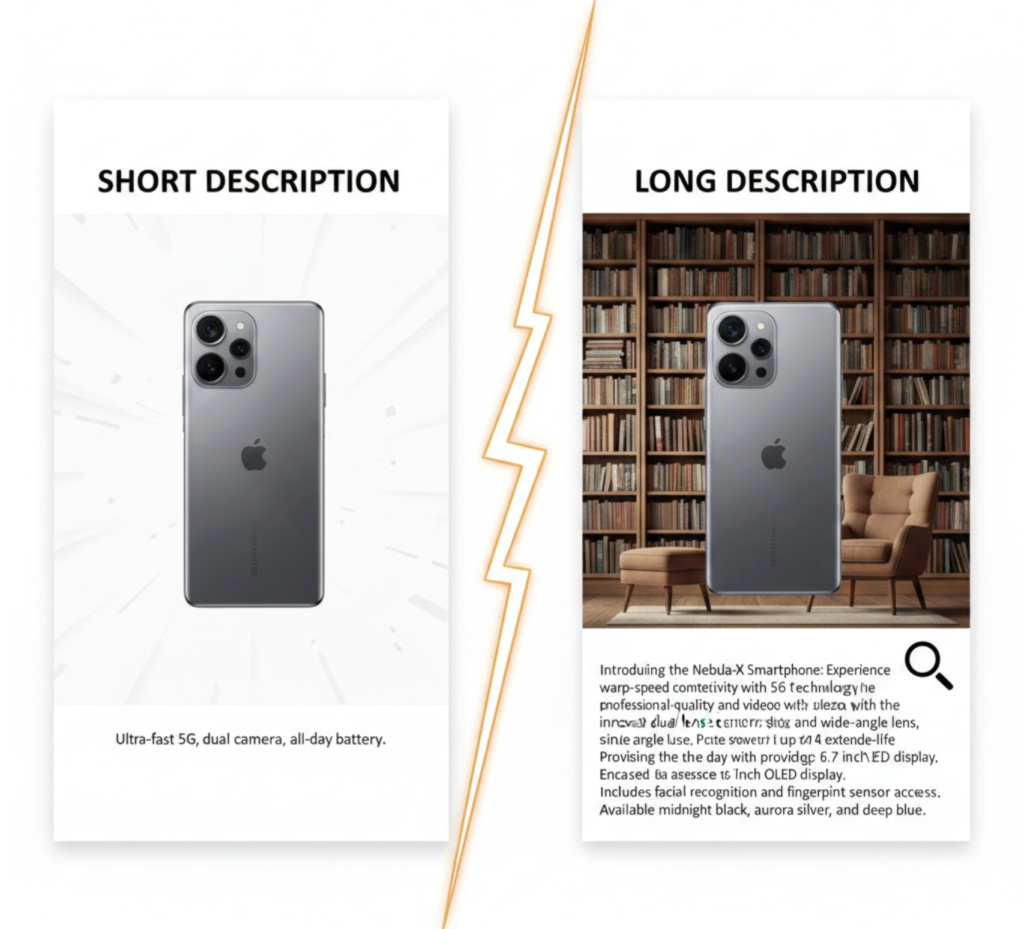
Short description vs long description
In a standard Magento installation, there are two primary text attributes for products:
- Short description: Usually appears near the “Add to Cart” button or at the top of the product page. Its role is to provide a quick hook—a summary of the primary value proposition.
- Long description: Typically found in the tabs section below the main product imagery. This is where you provide the deep-dive details, technical specs, and use-case stories.
How Magento renders product content
Magento uses a layout system based on XML and templates (PHTML files). Depending on your theme, the product description might be rendered in a tabbed interface or an accordion. It is vital to ensure that your text is formatted with proper HTML tags (h3, h4, p, ul) so the theme renders it cleanly. Unformatted text pulled from a database can look like a disorganized mess on the frontend.
Relationship with meta descriptions and category pages
While the product description lives on the product page, it also influences other areas. Magento often uses a snippet of the product description for the meta description if a custom one isn’t provided. Furthermore, category pages may display a “teaser” from the short description. Consistent messaging across these touchpoints ensures a cohesive user journey.
Structured data and attributes
SEO in Magento isn’t just about the text box. Attributes (like color, material, or weight) are used to populate Schema.org structured data. This helps search engines understand the product’s physical properties, price, and availability, which can lead to rich snippets in search results.
Read more: SEO-First Content Hub Inside Magento stores
Conversion-First Product Description Framework (Built for Magento Stores)
A high-converting description follows a psychological path that moves the customer from curiosity to confidence.
Writing for buying intent
Instead of listing what a product is, describe what a product does for the user. Focus on the transformation. If you are selling a high-end coffee maker, don’t just say it has a “stainless steel boiler.” Say it “reaches the perfect brewing temperature in 30 seconds, so you never have to wait for your morning espresso.”
Structuring descriptions for scannability
Most online shoppers do not read every word; they scan. Use:
- Descriptive subheadings: Instead of “Features,” try “Why You’ll Love It.”
- Bullet points: Perfect for highlighting key benefits quickly.
- White space: Keep paragraphs short (2-3 sentences) to prevent visual fatigue.
Translating technical specs into benefits
Every technical specification should be paired with a benefit.
- Spec: 5000mAh Battery.
- Benefit: Power through two full days of use without needing a charge.
Matching tone and depth to product type
A $10 t-shirt requires a short, punchy, lifestyle-oriented description. A $2,000 professional camera requires a long, detailed, and technically authoritative description. Align your depth with the level of investment the customer is making.
How to Apply SEO Naturally without Keyword Stuffing
SEO should be the invisible skeleton of your product description, supporting the structure without poking through the surface.
Identifying primary and secondary keywords
Research the terms your customers actually use. If you sell “athletic footwear,” but your customers search for “running shoes for flat feet,” your description needs to reflect that language. Use tools to find one primary keyword and 3-4 secondary, related terms.
Where keywords should appear in Magento
Strategic placement is more important than frequency:
- The first 100 words: Mention the primary keyword once early on.
- Subheadings: Use secondary keywords in H3 tags.
- Image Alt Text: This is a natural place for descriptive keywords that help both SEO and accessibility.
- URL Key: Ensure the Magento URL key contains your primary keyword.
Using synonyms and contextual terms
Instead of repeating “ergonomic office chair” ten times, use terms like “supportive workspace seating,” “adjustable desk chair,” or “lumbar-friendly furniture.” This technique, known as LSI (Latent Semantic Indexing), helps search engines understand the context of your page without triggering spam filters.
Aligning with category-level SEO intent
Product descriptions should support the category they belong to. If a product is in a “Eco-Friendly Cleaning Supplies” category, the product description should emphasize its sustainable ingredients to reinforce the relevance of the entire section of the site.
For more advanced control over these elements, you might consider implementing a specialized Magento SEO extension. For example, the BSS Commerce Magento 2 SEO Extension allows you to manage metadata, canonical tags, and SEO rules at scale—especially useful for large catalogs or multi-store setups.
Learn more here: https://bsscommerce.com/magento-2-seo-extension.html
Practical Magento Writing Guidelines (Short vs Long Descriptions)
Effective Magento management requires a disciplined approach to how you fill your data fields.
The Short Description (The “Hook”)
This should be 25-50 words. Its goal is to answer the question: “Why should I keep looking at this product?” Use an active voice and lead with the most significant benefit.
The Long Description (The “Closer”)
This is the space for 200-400 words (or more for complex items). Address common objections here. If a product is expensive, explain the craftsmanship. If it’s complex, explain the ease of setup.
Ideal length ranges
While there is no “magic number” for SEO, aim for at least 200 words of unique content to avoid “thin content” penalties from Google. However, never add fluff just to reach a word count.
Handling variant products
If you have products with multiple colors or sizes (Configurable Products in Magento), do not write unique descriptions for every single child product unless they have significantly different use cases. Use the “parent” product to host the main SEO-rich description to avoid internal duplicate content issues.
Common Magento Product Description Mistakes to Avoid
Avoiding these pitfalls will put you ahead of 80% of your competitors.
- Copy-pasting from suppliers: This is the fastest way to kill your SEO. Even if the manufacturer’s description is good, rewrite it to match your brand’s voice.
- Writing for engines only: If a human can tell you were trying to rank for a keyword, you’ve failed.
- Overloading with specs: Technical data belongs in the “Attributes” tab, which Magento renders as a clean table. Keep the description area for persuasive prose.
- Ignoring mobile layout: Magento themes can sometimes truncate descriptions on mobile. Always check how your text looks on a smartphone screen.
- Isolated assets: Remember that the description is part of a whole. It must work in harmony with your images, reviews, and pricing.
Example Structure of a High-Converting, SEO-Safe Magento Product Description
To visualize these principles, follow this template for your next product upload:
- Headline (H2): A bold statement of the product’s main value.
- Intro Paragraph: 2-3 sentences connecting the product to a customer problem.
- Benefit Bullets: 4-5 points highlighting the “why” behind the “what.”
- Contextual Paragraph: A brief story or use-case scenario.
- Technical Highlight: A small section for the most important “deal-breaker” specs.
- Closing Reassurance: A sentence about warranty, quality, or your brand’s mission.
Measuring Whether Your Product Descriptions Are Actually Working
Data-driven refinement is the final step in the process.
Key Magento metrics to monitor
- Conversion Rate (CR): If traffic is high but sales are low, the description might not be persuasive enough.
- Add to Cart Rate: A low rate here often suggests the short description or “hook” isn’t working.
- Time on Page: If users spend less than 30 seconds on a complex product page, they aren’t reading your content.
Signs of over-optimization
If you notice your product ranks well for a specific term but has a very high bounce rate, you may have “tricked” users into clicking a page that doesn’t actually provide the helpful reading experience they expected. Conversely, under-optimized pages may have great conversion rates but very low organic traffic.
Using A/B testing
Magento 2 Commerce (Adobe Commerce) includes staging and preview tools that allow you to test different content versions. For Open Source users, third-party tools can help you swap descriptions to see which version drives more “Add to Cart” actions.
Long-term strategy
Product descriptions are not “set it and forget it” assets. As market trends change and customer feedback comes in through reviews, update your descriptions to address new questions or highlight newly discovered use cases. This keeps the content fresh for both shoppers and search engine crawlers.
By focusing on the shopper’s needs first and using Magento’s technical capabilities second, you create a sustainable SEO strategy that builds brand authority and drives consistent sales growth.
Conclusion
Crafting high-converting product descriptions in Magento is a balancing act that requires a deep understanding of your audience’s pain points and the technical nuances of the platform. While SEO provides the roadmap that leads customers to your store, it is your content’s clarity, benefit-driven structure, and emotional resonance that ultimately secures the sale.
By avoiding the trap of keyword stuffing and focusing on scannable, human-centric layouts, you create an environment where search engines can easily index your site and users can shop with confidence. Remember that the best SEO results often come as a byproduct of a superior user experience. Continually monitor your Magento analytics, iterate on your messaging, and treat every description as a vital part of your overall brand story to drive sustainable e-commerce growth.