

In the highly competitive Magento ecosystem, A/B testing is an essential tool for making data-driven decisions that enhance user experience and increase conversion rates. However, merchants and SEO specialists often worry that these experiments might inadvertently harm organic visibility by creating duplicate content or slowing down page speeds. Balancing innovation with technical stability is critical to ensuring that testing variants do not negatively impact the store’s established search engine rankings.
Rather than treating them as conflicting goals, modern search algorithms now prioritize user engagement—a direct outcome of successful A/B testing—as a vital ranking signal. Understanding how Magento A/B testing can influence both UX and SEO allows businesses to implement technical “guardrails,” such as correct canonical signaling and performance optimization. This guide provides a comprehensive framework to run experiments that drive immediate revenue while safeguarding and potentially strengthening your long-term organic search presence.
What is A/B testing in Magento?
A/B testing in an e-commerce context is the process of showing two or more variations of a page to different segments of visitors at the same time to determine which one results in the highest conversion rate or engagement. In a Magento environment, this usually involves a “Control” (the current version) and a “Variant” (the modified version).
Common elements tested in Magento stores
Magento’s flexible architecture allows for a wide range of elements to be tested:
- Product pages: Merchants often test the placement of “Add to Cart” buttons, the layout of product images, the prominence of trust badges, or the complexity of product descriptions. Executing a structured approach to A/B testing Magento product pages layouts for SEO and conversion optimization is the most effective way to ensure these changes actually resonate with your specific buyer personas.
- Category layouts: Testing the number of products displayed per row, the visibility of “Quick View” buttons, or the effectiveness of promotional banners at the top of category grids.
- Navigation and filters: Experiments might involve reordering the main menu, changing the terminology used in layered navigation, or testing “Sticky” vs. standard headers.
- CTAs and checkout flows: This includes testing different button colors, micro-copy (e.g., “Buy Now” vs. “Add to Basket”), or simplifying the steps in a one-page checkout.
Overview of Magento A/B testing tools and methods
Magento store owners typically implement A/B testing through two primary methods. Client-side testing involves using a tool like VWO, Optimizely, or Adobe Target to inject JavaScript into the browser, which modifies the page content after it is loaded. Server-side testing, which is more robust but technically demanding, involves the Magento server itself deciding which version of the page to serve before the data is sent to the user. This is often achieved through custom modules or specialized B2B and enterprise-level testing platforms.
How A/B testing influences user experience (UX)

The fundamental goal of A/B testing is to enhance the user’s journey through the storefront by systematically removing interaction friction. When a merchant identifies a pain point and tests a solution, they are not just changing a button color; they are optimizing the cognitive efficiency of the site.
Improving usability and product discovery
A/B testing allows Magento merchants to validate whether their product discovery features—such as related products or faceted search—are actually helping users find what they need or causing “choice paralysis.” For example, testing the addition of a “Popular Filters” section can significantly reduce the interaction cost by providing a stronger “information scent.” In complex B2B catalogs, testing SKU-based search vs. attribute-based search can reveal how professional buyers prefer to navigate deep hierarchies. By analyzing the “Time to First Action,” merchants can refine navigation to ensure users reach the checkout path with minimal cognitive load.
Testing layout, design, and content changes
Design choices are often subjective, but A/B testing introduces empirical evidence into the creative process. Merchants can test “Visual Hierarchy” by reordering elements based on the F-pattern or Z-pattern reading behaviors. A common experiment involves testing a minimalist product detail page (PDP) against a feature-rich version that includes technical specs, social proof, and video content. This helps determine the optimal “Information Foraging” balance for your specific audience. Testing different “Affordances”—visual cues that suggest how an element should be used—can also prevent user frustration, such as making sure that mobile-only buttons are clearly tappable and large enough to meet accessibility standards.
Impact on engagement metrics
Successful UX improvements are reflected in behavioral data that signals high-quality interaction. Specifically, identifying and eliminating checkout UX friction in Magento through iterative testing allows you to transform a complex payment process into a streamlined, high-converting funnel. When a test successfully reduces friction, merchants typically see an increase in click-through rates (CTR) on primary CTAs and a significant reduction in “Pogo-sticking”—where a user clicks a result and immediately returns to the previous page. Furthermore, by measuring “Micro-conversions,” such as newsletter sign-ups or “Add to Wishlist” actions, merchants can track how layout changes influence long-term brand affinity. These improvements signal that the visitor finds the site valuable, which is the ultimate goal of high-quality UX design in the Magento ecosystem.
How UX improvements indirectly affect SEO
While A/B testing is primarily focused on conversions, the resulting UX improvements have a profound indirect impact on SEO. Search engines aim to provide users with the best possible results; therefore, a site that satisfies its users is inherently more likely to rank well.
Relationship between user behavior signals and SEO
Google uses various signals to determine the “quality” of a webpage. If a user clicks on a search result and immediately “pogo-sticks” back to the SERP (search engine results page), it suggests the page did not meet their intent. Conversely, if a user lands on a Magento store and interacts deeply with the content due to a successful A/B test, it signals to Google that the page is relevant and high-quality.
How better UX can improve crawl efficiency
A simplified, better-organized navigation menu—proven through A/B testing—doesn’t just help humans; it helps crawlers. A logical internal linking structure ensures that search engine bots can discover and index deep product pages more efficiently. When UX testing leads to a flatter site architecture, the overall SEO health of the store improves.
UX-driven improvements and long-term SEO growth
Misconceptions often persist that SEO is only about keywords and backlinks. However, modern SEO is increasingly synonymous with UX. Improvements such as mobile-first layouts, clearer font sizes, and optimized button placements are all UX wins that Google’s Core Web Vitals algorithms reward with higher visibility.
How A/B testing can impact SEO in Magento

Despite the benefits, A/B testing carries technical risks if not managed correctly. Navigating how Magento A/B testing can influence both UX and SEO involves identifying technical risks that are primarily related to how search engines perceive the temporary changes being made to the site and the underlying codebase.
Potential SEO risks of A/B testing
The most significant risk is duplicate content arising from poor URL management. If a merchant creates a completely separate URL for a test variation (e.g., domain.com/product-a and domain.com/product-a-test) and fails to use a canonical tag, search engines may struggle to decide which page is the original. This leads to “Ranking Dilution,” where link equity is split between two versions, causing neither to rank effectively.
Another risk is indexation of test URLs, which causes “Index Bloat.” If a temporary test page is accidentally indexed, it may appear as a broken link once the test is concluded, leading to a spike in 404 errors. Finally, there is the concern of “Cloaking”—showing different content to search engines than to users. While A/B testing is generally safe, a test that significantly alters the “Content-to-Code” ratio only for certain user agents could be misinterpreted by search engine bots as a manipulative practice designed to hide low-quality content.
How search engines interpret A/B tests
Google’s stance is clear: A/B testing is an acceptable and necessary practice for modern web development. Googlebot is sophisticated enough to understand that websites need to run experiments to improve their performance. The key factor is “Intent.” As long as you are not using the test to deceive the search engine or serve malicious content, you are unlikely to face penalties. Google recommends keeping tests temporary and using the correct technical signals, such as 302 (Found) redirects instead of 301 (Moved Permanently) for URL-based tests. This signals to the bot that the original URL is still the authoritative version and should be kept in the index, ensuring that your long-term organic presence remains stable throughout the experiment.
Common Magento A/B testing SEO issues
In the context of a Magento store, certain technical hurdles frequently lead to SEO complications during testing.
Poorly configured URLs and parameters
Magento is prone to URL bloat. If a testing tool adds tracking parameters to the URL (e.g., ?test_group=b), and these parameters are not handled correctly in Magento’s configuration or through robots.txt, crawlers may perceive these as thousands of unique, duplicate pages.
Missing or incorrect canonical tags
Many Magento themes have complex canonical logic. During an A/B test, it is vital that the variant page points its canonical tag back to the control URL. If the canonical tag is missing or self-referencing on the variant, search engines lose the “source of truth” signal. To manage these signals effectively, merchants often integrate a specialized Magento 2 SEO extension to automate canonical management during complex testing scenarios.
JavaScript-based testing performance issues
Client-side testing tools often cause a “flicker” effect, where the original content is visible for a split second before the variant loads. This not only hurts UX but can also negatively impact Core Web Vitals, specifically Cumulative Layout Shift (CLS) and Largest Contentful Paint (LCP). Since these are now direct ranking factors, a poorly performing A/B test script can cause a temporary dip in organic rankings.
Best practices for SEO-safe A/B testing in Magento
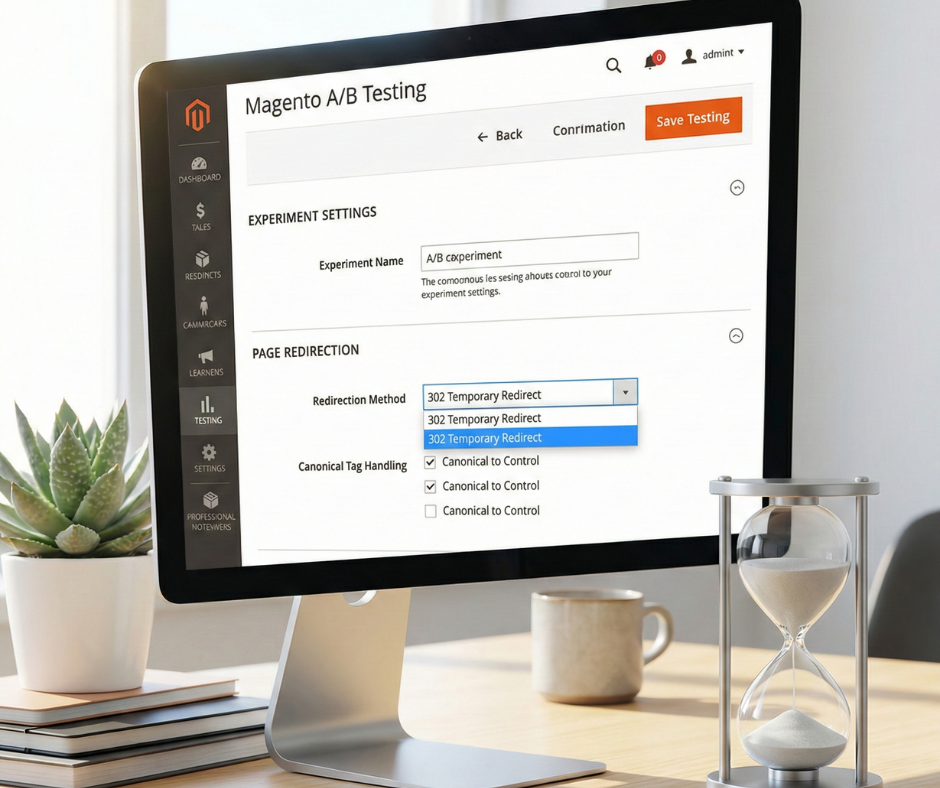
To ensure your experiments do not compromise your SEO, you must follow a disciplined technical protocol.
Use canonical tags correctly during tests
The canonical tag is your most powerful defense against duplicate content. Regardless of whether you are testing on the same URL (via JavaScript) or a separate URL (via a redirect), the variant must always contain a canonical link pointing to the original, preferred URL. This tells Google: “I know there are two versions, but please only index and give credit to the original one.”
Control indexing of test variations
In most cases, you should prevent search engines from indexing your test variants. If you are using separate URLs for your split test, apply a noindex meta tag to the variant page. However, avoid using robots.txt to block test URLs, as this prevents crawlers from seeing the canonical tag, which can be counterproductive.
Manage server-side vs client-side testing
Server-side testing is generally the safer option for SEO because it eliminates the “flicker” effect and the performance overhead of heavy JavaScript libraries. If you must use client-side testing, ensure your script is optimized and placed correctly in the <head> of your Magento templates to minimize the impact on Core Web Vitals.
Keep A/B tests temporary and clean
A/B tests are not permanent design changes. Google expects these experiments to have a beginning and an end. Once you have a statistically significant winner, conclude the test, remove the variant URLs, and implement the winning changes permanently on the original page. Leaving “zombie” test pages live for months after an experiment is a leading cause of index bloat in Magento stores.
Final thoughts
Magento A/B testing acts as a powerful catalyst for growth that, when executed with deep respect for technical SEO, identifies the specific content and layouts users value most. By moving beyond simple conversion metrics, these experiments provide a roadmap for long-term organic success, ensuring that design changes contribute to a more authoritative and user-centric search presence.
The key to navigating the influence of A/B testing on UX and SEO lies in risk management and cross-team collaboration. By prioritizing a “UX-first, SEO-safe” approach and ensuring technical signals like canonicals are handled correctly, Magento merchants can turn their storefront into a laboratory for innovation. Ultimately, this synergy allows businesses to build a more resilient, higher-converting brand that is supported by both behavioral data and search engine requirements.