
In the global eCommerce landscape, the ability to reach international markets is one of Magento’s most significant competitive advantages, yet success in 2026 requires more than simple translation. A sophisticated fusion of cultural localization and technical SEO is essential to transform content into a high-performance marketing asset that resonates with local buyers while satisfying search algorithms. Mastering Magento multi-language marketing: Combining localization with SEO best practices is the key for any brand aiming for global dominance and high-ranking organic visibility.
This guide provides a comprehensive framework to resolve the common conflict between creative localization and technical structure, which often leads to technical debt. Marketers, SEOs, and developers will learn how to choose optimal multi-store architectures, perform market-specific keyword research, and implement critical “guardrails” like hreflang and canonical tags. By treating these disciplines as a single system, you ensure your Magento store becomes a dominant, authoritative force in every market it enters while providing a seamless user experience.
Understanding localization vs SEO in Magento
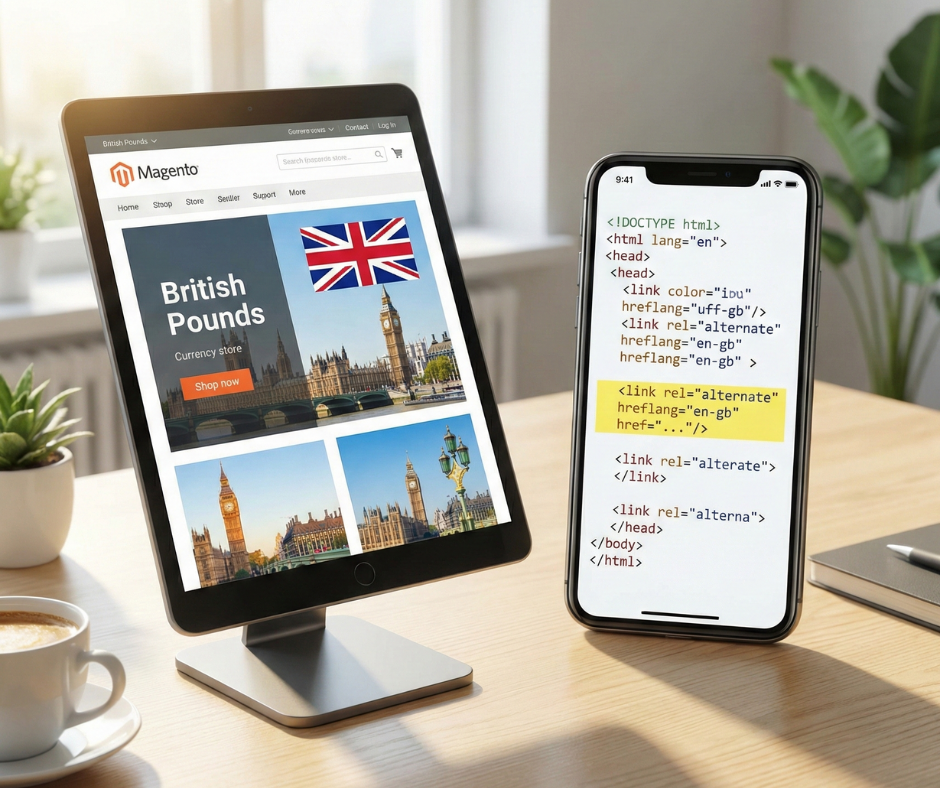
To master international marketing, one must first distinguish between the linguistic act of translation and the strategic operation of localization, then understand how both interact with SEO.
What localization really means in eCommerce
Localization is the process of adapting a product, service, or content to a specific locale or market. In a Magento store, this encompasses language, cultural nuances, currency, local measurement systems, and specific user expectations. Translation is merely the first step; localization is about making the user feel like the site was built specifically for their region.
For example, a US-based Magento store selling “apparel” must localize to “clothing” or “garments” for the UK market. Beyond words, it involves using local trust signals, such as regional payment methods (e.g., PIX in Brazil or Klarna in Germany) and adhering to local legal requirements like GDPR. Localization is for the human visitor; it builds the trust necessary to convert traffic into revenue.
How SEO interacts with localization
While localization serves the human, SEO serves the machine. Search engine optimization provides the structure that makes your localized content discoverable. This technical foundation is a key pillar among the digital marketing trends in 2026 for Magento stores, where search engines increasingly prioritize sites that provide highly relevant, locally optimized experiences for global users. Search intent varies wildly across languages even for the same product. A user in Spain might search for a product based on its technical specifications, while a user in Mexico might use more colloquial terms for the same SKU.
SEO structure must come before translation. If you translate your content without first establishing the technical URL structure and performing local keyword research, you risk creating a site that is linguistically perfect but invisible to Google. The goal of combining these disciplines is to ensure that search engines understand which version of a page is intended for which specific audience, ensuring the right language version appears in the right local search engine results page (SERP).
Choosing the right Magento multi-language setup
Magento’s core strength is its hierarchical architecture. Deciding how to structure your multi-language environment is the most critical technical decision you will make.
Store views, websites, and domains
Magento offers three primary ways to handle multiple languages, each with distinct SEO implications:
- Store views: This is the most common method for multi-language setups. Different languages are handled as Store Views under a single Website. This is easiest to manage from an inventory perspective, as all languages share the same product database. SEO-wise, this is typically handled via subdirectories (e.g., brand.com/fr/).
- Subdomains: Some merchants use subdomains (e.g., fr.brand.com). While this provides a clear separation of content, Google often treats subdomains as separate entities, which can split your domain authority and make it harder to rank new pages.
- Top-level domains (ccTLDs): Using brand.fr for France and brand.de for Germany is the strongest signal to search engines and users that your site is truly local. However, this is the most expensive and complex to manage, requiring separate SSL certificates and often separate Magento Websites to handle different base currencies and tax rules.
For most Magento stores, the subdirectory approach via Store Views is the optimal balance of SEO authority consolidation and administrative efficiency.
URL structure best practices
Consistency is the foundation of international SEO. Regardless of the architecture chosen, your language identifiers in URLs must be logical and follow ISO 639-1 (for languages) and ISO 3166-1 (for regions) standards.
Avoid using session IDs or non-descriptive parameters (like ?lang=fr) for language switching. These are difficult for search engines to crawl and provide no keyword value. In Magento, ensure that your “URL Key” for products and categories is translated for each Store View. A URL like domain.com/fr/chaussures-de-course is significantly more powerful for French SEO than domain.com/fr/running-shoes.
Localized keyword research for multi-language SEO
A common mistake in international marketing is assuming that a direct translation of a high-volume English keyword will yield high-volume results in another language. This is rarely the case.
Why keywords don’t translate 1:1
Keywords are a reflection of culture and intent. In the US, a popular search might be “affordable cell phones,” while in the UK, the term “cheap mobile phones” might have ten times the search volume. In languages like Japanese or Chinese, the distinction between formal and informal scripts can create entirely different search landscapes for the same product.
Performing keyword research per market is non-negotiable. Use tools like Ahrefs, SEMrush, or Google Keyword Planner, but ensure you are setting the geographic location and language correctly. Look for “Local Search Intent”—are users searching for information, or are they ready to buy?
Mapping keywords to localized category and product pages
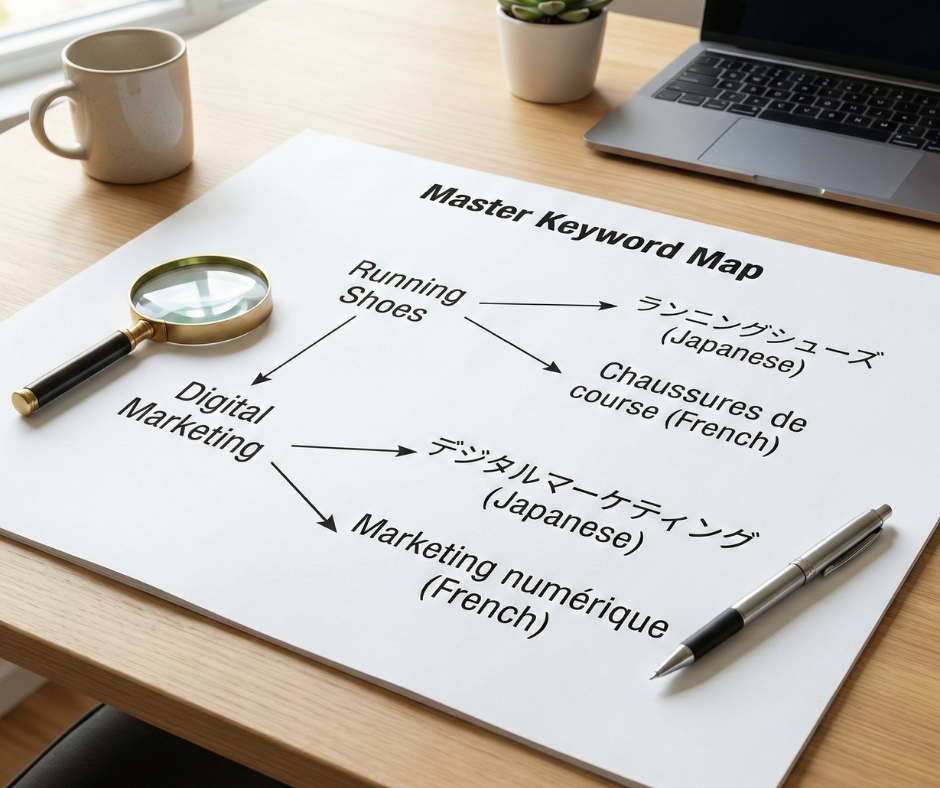
Once research is complete, create a “Master Keyword Map”. This map acts as a strategic guide for your broader Magento online marketing activities, ensuring that every piece of translated content is backed by real-world search demand in its specific target market. In Magento, these keywords should be used to optimize the following fields per Store View:
- Category Names and Descriptions.
- Product Names and Short Descriptions.
- URL Keys (Slugs).
- Image Alt Text.
By mapping keywords before translating, you provide your linguists with a “Glossary of Intent,” ensuring that the final copy is optimized for search from the first draft.
Creating SEO-friendly localized content
Content is where localization and SEO are most visible to the user. High-quality localized content reduces bounce rates, which is a vital engagement signal for modern search algorithms.
Product and category content localization
Avoid the temptation to use automated machine translation without human review. While AI has improved, it often fails to capture the “Commercial Tone” required for eCommerce.
- Localized product descriptions: Focus on regional benefits. If you are selling an outdoor jacket in Canada, emphasize its insulation and warmth. For the same jacket in a rainy UK market, focus on its waterproofing and breathability.
- Category page optimization: Category pages are the “hubs” of your Magento store. Localized category descriptions should include internal links to other relevant localized products, passing link equity through the specific language structure. Ensure that any “Promotional Banners” within categories are also localized; a US “Labor Day” sale has no relevance to a French shopper.
Metadata and heading localization
Metadata is the first interaction a user has with your brand in the SERPs. It must be both keyword-rich and persuasive.
- Title tags: Must be unique for every Store View. Include the primary localized keyword at the beginning of the title.
- Meta descriptions: These do not directly impact rankings, but they significantly impact Click-Through Rate (CTR). Localize your USP (Unique Selling Proposition). If you offer “Next-day delivery” in the US but “3-day delivery” in Australia, your meta descriptions must reflect that reality to maintain trust.
- Heading hierarchy (H1–H6): Maintain a strict heading structure across languages. The H1 should be the localized product name, and H2s should focus on features or benefits using secondary localized keywords.
Implementing technical SEO for multi-language Magento stores

Technical SEO is the “plumbing” that ensures search engines can find and properly attribute your localized content. Following Magento multi-language marketing: Combining localization with SEO best practices ensures that technical signals like hreflang and canonicals are handled correctly to prevent index confusion.
Hreflang implementation
Hreflang is a simple HTML attribute that tells search engines which language you are using on a specific page, so the search engine can serve the correct result to users searching in that language. In Magento, this is typically implemented in the <head> of the page.
A correct hreflang tag looks like this: <link rel=”alternate” href=”https://example.com/fr/” hreflang=”fr” />
Language vs language-region targeting: If you have separate stores for the US and UK, use en-US and en-GB. If you only have one English site for the world, use en. Common mistakes: The most frequent error is missing “Return Tags.” If Page A points to Page B, Page B must point back to Page A. Managing these tags manually across thousands of SKUs is complex, making a professional Magento SEO suite essential for automating the hreflang XML sitemap generation.
Canonicalization and duplicate content control
Canonical tags tell search engines which version of a URL is the “master.” In a multi-language setup, the canonical tag should almost always be self-referencing.
- The canonical on domain.com/en/product should point to domain.com/en/product.
- The canonical on domain.com/fr/product should point to domain.com/fr/product.
Never point a localized page’s canonical tag to the English version. This tells Google that the French page is just a duplicate and should not be indexed, effectively killing your international SEO efforts. Hreflang handles the relationship between languages; canonicals handle the relationship between URL variations within a single language.
UX considerations that support both localization and SEO
User experience (UX) is an indirect but powerful SEO factor. If a user lands on the wrong language version and immediately bounces, Google interprets the page as low-quality for that query.
Language switcher best practices
Your language switcher must be crawlable. Many Magento themes use JavaScript-based switchers that bots cannot follow. Ensure your switcher uses standard <a> tags with href attributes.
- Placement: The top-right header or the footer are standard locations.
- Manual detection: While automatic IP-based redirection seems user-friendly, it is dangerous for SEO. Search engine bots often crawl from US-based IP addresses. If you automatically redirect all US IPs to your English store, Googlebot may never see your French or German pages. The best practice is to show a “Suggested Language” banner but allow the user to make the final choice.
Cultural UX optimization
Trust is regional. To improve engagement and conversion, localize your trust signals:
- Currency and formatting: Show prices in local currency with correct separators (e.g., $1,200.00 in the US vs 1.200,00 € in Germany).
- Imagery: Use images that reflect the local demographic and environment. A winter apparel store in the Nordic countries should use imagery of snow and mountains, not a generic urban park.
- Social proof: Feature reviews from customers in that specific region first. A French shopper is more likely to trust a review from a fellow citizen than a translated review from a US buyer.
Performance and technical considerations at scale
Multi-language Magento stores often suffer from performance bloat due to the sheer volume of data being processed.
Page speed impact of multi-language content
Every Store View adds rows to your database. Large catalogs with 10+ languages can slow down price indexers and URL rewrites. To maintain high Core Web Vitals scores, utilize Full Page Caching (Varnish) and ensure your server is optimized for the additional database load.
- CDN (Content Delivery Network): For a global audience, a CDN like Cloudflare or Fastly is mandatory. It serves static assets from the server closest to the user, drastically reducing Time to First Byte (TTFB).
- Global delivery: If you have high traffic in both Europe and Asia, consider a multi-region hosting setup to ensure that latency doesn’t kill your conversion rates or your rankings.
JavaScript-rendered content and SEO risks
Many modern Magento themes (especially those using PWA Studio or Hyvä) rely on JavaScript for dynamic elements. Ensure that your localized content—especially the H1 tags and metadata—is rendered on the server (SSR). If Googlebot has to execute complex JavaScript just to find out what language a page is in, your crawl budget will be wasted, and your indexation will suffer.
Common mistakes when combining localization and SEO
- Translating content without keyword research: This leads to “Perfectly written, never found” content. Ignoring Magento multi-language marketing: Combining localization with SEO best practices at the research phase is the most common cause of international traffic stagnation.
- Incorrect hreflang and canonical setup: This is the #1 cause of international SEO failure. It leads to index confusion and “keyword cannibalization” across languages.
- Indexing all languages without a strategy: If you only have “placeholder” translations for a language, do not index it. Low-quality, thin content in a new language can drag down the authority of your primary store.
- Ignoring UX in localization: If the currency is wrong or the date format is confusing, users will bounce, signaling to Google that the page is irrelevant.
Conclusion
Combining localization and SEO in Magento is an ongoing strategy that rewards merchants with lower customer acquisition costs and higher brand authority in local markets. By treating these two disciplines as a unified system, every cultural adaptation for the human user becomes a positive signal for search engines. Transitioning toward this “Gold Standard” technical setup is the most resilient way to build a global commerce engine that can adapt to shifting consumer behaviors and international search trends.
Ultimately, adhering to Magento multi-language marketing: Combining localization with SEO best practices allows you to build a brand that feels native to local shoppers while maintaining a global technical standard. Your immediate next steps should be auditing your current hreflang return tags, verifying canonical logic, and mapping deep search intent for your top categories. By providing search bots and humans with a clear, relevant path to purchase, you ensure your Magento store thrives and scales effectively on the global stage.