
In the current eCommerce landscape, personalization has moved from being a luxury to a fundamental requirement for conversion rate optimization (CRO). Magento merchants frequently utilize customer segments, behavioral triggers, and targeted banners to provide shoppers with a tailored experience that encourages higher average order values and increased brand loyalty. When a visitor sees a discount specifically aligned with their previous browsing history or geographic location, the likelihood of a conversion spikes.
However, a significant technical challenge exists: search engines are built on the premise of consistency and predictability. Mastering the art of personalizing Magento promotions without hurting SEO is therefore a critical skill for eCommerce managers who want to drive revenue without sacrificing the store’s hard-earned organic rankings. This guide explores the intersection of professional marketing tactics and technical SEO requirements, providing a framework for implementing a personalization layer that remains completely invisible to search engine crawlers.
Why Magento promotion personalization can hurt SEO
The primary reason personalization poses a threat to search engine optimization is that it breaks the “one-to-one” relationship between a URL and its content. Search engines index pages based on the static HTML they see during a crawl. If that HTML changes too frequently or based on the wrong triggers, several technical issues arise.
Duplicate content and URL variations
A common mistake in Magento is using URL parameters to trigger promotions. For example, a merchant might use a URL like domain.com/shoes.html?promo=winter_sale to show a specific banner. If this parameter is not handled correctly, Google may index both the clean URL and the version with the parameter as two separate pages. Since the content is 95% identical, this results in a duplicate content penalty, diluting the ranking power of the original category page.
Crawl budget and indexation issues
If your personalization logic creates thousands of unique URL permutations—perhaps based on session IDs or tracking parameters—search engine bots can get trapped. This is known as a crawl trap. Googlebot has a finite amount of time to spend on your site (crawl budget). If it spends that time crawling variations of the same promotionally-tagged page, it may never reach your new product pages or high-value blog posts.
Inconsistent content for users vs search engines
If a search engine sees a generic “Welcome” banner while a user sees a “50% Off for VIPs” banner that contains different H1 tags or keyword-rich copy, Google may perceive this as “cloaking.” Cloaking is a violation of search engine guidelines where the content presented to the search engine spider is different from that presented to the user’s browser. While personalization is rarely intended as a manipulative tactic, an accidental discrepancy in core SEO elements can lead to manual penalties or ranking instability.
Personalization based on cookies, sessions, or parameters
Magento often handles personalization via cookies or session data. If your promotional logic is hard-coded into the server-side templates (PHTML files), the server must decide which version to serve before the data is sent. If the crawler is not identified correctly, or if the server defaults to a “logged-in” state for the bot, the indexed version of the page will be skewed. This inconsistency makes it difficult for search engines to determine the topical authority of the page.
Core principles for SEO-safe Magento personalization
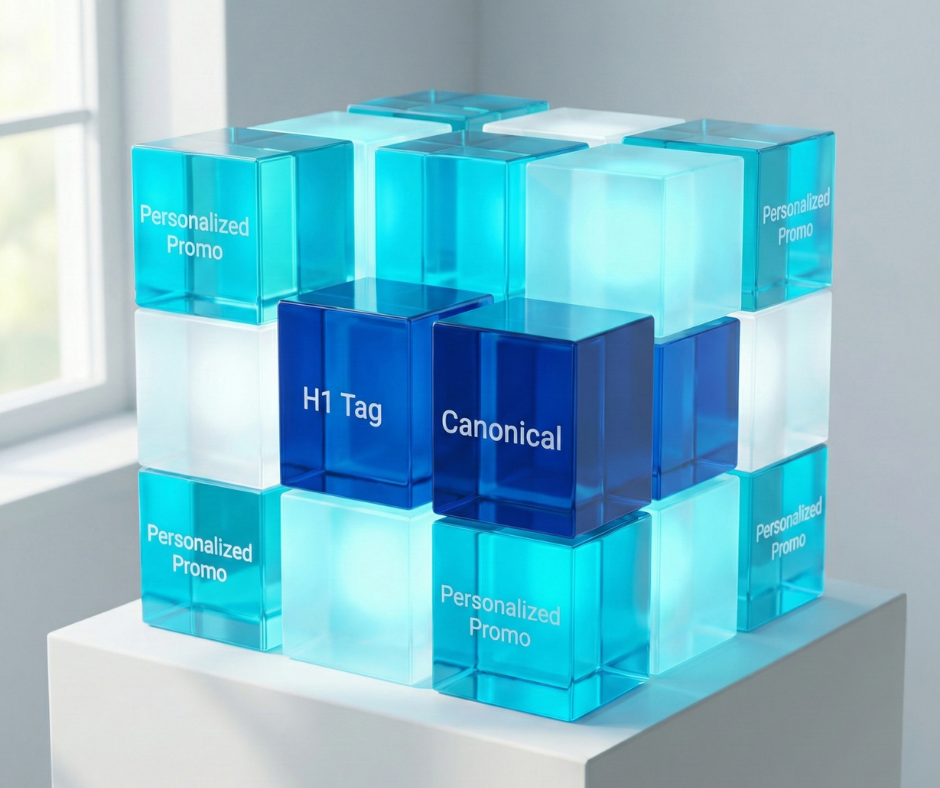
The technical objective of personalizing Magento promotions without hurting SEO is centered around architectural stability. You must adhere to a set of principles that prioritize the search engine’s need for a consistent “source of truth.”
One canonical version per URL
Regardless of how many promotional variations exist for a page, there must be one “source of truth.” Every personalized version of a page should explicitly point to the default, non-personalized URL using a canonical tag. This tells search engines: “I know you might see different things here, but this original URL is the only one you should index and reward with rankings.”
Clear separation between SEO content and personalized content
You should never personalize elements that are primary ranking signals. This includes the <title> tag, the Meta Description, the H1 heading, and the main body text (product descriptions). Personalization should be limited to “transient” elements like top-of-page banners, sidebar callouts, or “recommended for you” blocks. By keeping the “bones” of the page static, you ensure that the search engine always understands the core intent of the page.
Consistent HTML output for crawlers
When a bot requests a page, the HTML it receives should be identical to what a first-time, non-logged-in guest would see. Any personalized modifications should ideally happen after the initial page load or through specific technical “hole punching” that excludes bots.
Avoiding indexable parameter-based variations
Never allow search engines to crawl URLs containing promotion-triggering parameters. If you must use parameters, they should be “fragmented” using a hash (#)—which search engines usually ignore—or strictly managed through the robots.txt file and Google Search Console’s parameter tool.
Step-by-step: How to personalize Magento promotions safely
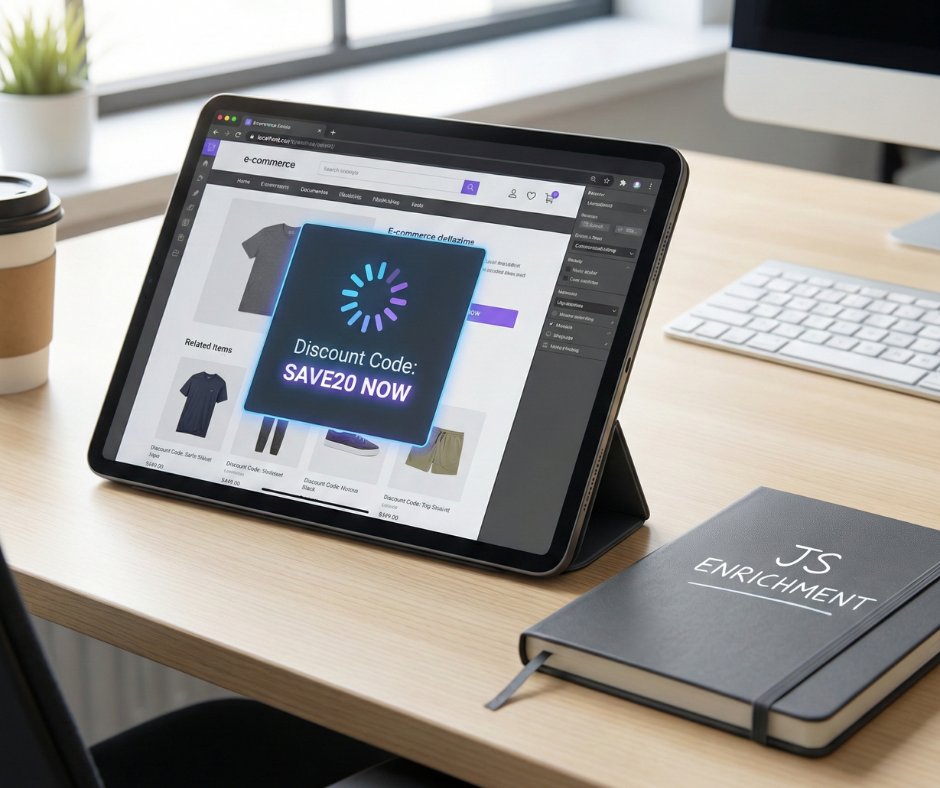
Implementing an SEO-safe strategy requires a technical architecture often referred to as “Progressive Enrichment.” This means building a high-quality static baseline that satisfies search bots and then layering dynamic personalization on top for human users.
Step 1 – define a non-personalized SEO baseline
The first task is to establish the “Global Guest State.” This is the version of your site that search engines will index and rank. It must represent the “common denominator” of your content—high-quality, keyword-optimized, and fully accessible without a user session.
To ensure your baseline is effective, you must:
- Lock core SEO elements: The H1 tag, meta title, and primary category descriptions must remain static. If you have a personalized promo, place it in a secondary <div> rather than modifying the primary heading.
- Maintain Schema.org integrity: Structured data (Product, Offer, AggregateRating) should reflect the public, non-personalized price and availability. Inconsistencies between your HTML and Schema can lead to rich snippet loss.
- Optimize for first-time discovery: The baseline should contain your most important internal links and marketing copy. Treat search engines as a “new visitor” that always receives your highest-standard generic content.
Once this baseline is locked, it serves as the “anchor” for your organic visibility. Any personalization that occurs afterward must not overwrite these core technical signals.
Step 2 – implement personalization layer correctly
The delivery mechanism is the most critical decision in personalizing Magento promotions without hurting SEO. For Magento merchants, the choice is between risky server-side modifications and the “Gold Standard” of client-side enrichment.
Server-Side Edge Side Includes (ESI) and Caching Risks Server-side personalization often interacts poorly with Full Page Cache (FPC) and Varnish. If you use ESI to “hole punch” a promo banner, you must ensure that the “hole” is strictly identified as private content. If misconfigured, the server might accidentally cache a personalized version meant for a VIP user and serve it to Googlebot, causing the search engine to index an incorrect version of your page.
The Client-Side “Hole Punching” Framework The most robust approach involves using Magento’s native “Private Content” logic (sections.xml) and JavaScript (Knockout.js or plain JS).
- Initial Page Load: The server sends the static, cached SEO baseline to everyone. Googlebot sees this and indexes it.
- Client-Side Trigger: After the page loads, a JavaScript snippet checks localStorage or makes an AJAX call to /customer/section/load/.
- DOM Enrichment: Once the user is identified as belonging to a “Loyalty” or “Regional” segment, the JS dynamically injects the promotional banner or discount code into the designated area. Integrating Magento loyalty programs through this client-side layer ensures that exclusive member-only offers remain completely invisible to search bots, protecting the page’s original topical authority while rewarding your best customers.
- SEO Benefit: Because Googlebot’s JavaScript execution is limited and it typically crawls without a session or cookies, it is highly likely to only see the static baseline. This guarantees that your promotion does not “leak” into the index or trigger “cloaking” flags.
Step 3 – control indexation and crawling
Even with a perfect JavaScript implementation, technical “guardrails” are necessary to prevent search engines from discovering and wasting resources on technical variations of your site.
- Strategic Canonicalization: Every page must have a self-referencing canonical tag. If you use tracking parameters (e.g., ?promo_id=123), the canonical tag must point to the “clean” URL (/shoes.html). This consolidates ranking power and prevents index bloat.
- Managing URL Rewrites: Avoid creating unique “URL Keys” for personalized segments. For instance, do not have /shoes-vip.html and /shoes-regular.html. Use one URL and vary the experience via the JS layer described in Step 2.
- Robots.txt and Parameter Handling: Use robots.txt to disallow crawling of specific technical directories or parameter strings that are only meant for promotional tracking. Additionally, use the “URL Parameters” tool in Google Search Console to mark promotional parameters as “Representative URLs,” instructing Google to ignore the variations.
- Noindex for Private Landing Pages: If you create dedicated landing pages for a specific email or social campaign that are highly personalized, apply the noindex meta tag. Following the best practices for Magento newsletter campaigns with SEO-friendly landing pages is critical here to avoid internal keyword competition between your private campaign offers and your primary organic categories. These pages are designed for conversion, not discovery, and keeping them out of the index prevents them from competing with your primary organic categories.
Magento-specific SEO controls for promotion personalization
Magento’s complex architecture—particularly its caching system and URL rewrite logic—requires specific attention when handling promotions. To manage these rules effectively, merchants often consult a list of Magento 2 extensions to boost your promotions strategies to find tools that support SEO-friendly delivery methods.
Magento URL structure and rule-based promotions
Magento allows for “Cart Price Rules” and “Catalog Price Rules.” Catalog rules change the price in the database and on the storefront, which is generally fine for SEO as long as the price change is site-wide. However, if a price rule is limited to a “Customer Group,” you must ensure that Magento is configured to show the “General” group price to search engines.
Managing promotion-related parameters
Magento often generates URLs with ?___store= or ?SID= parameters. When adding custom promotion parameters, go to Stores > Configuration > Catalog > SEO and ensure that “Use Canonical Link Meta Tag For Products” and “Categories” are both set to “Yes.” This is your first line of defense against parameter-driven duplicate content.
Caching considerations and Varnish interactions
Most high-performance Magento stores use Varnish or the built-in Full Page Cache (FPC). Caching is the enemy of personalization because it wants to serve the same saved HTML to everyone to save server resources.
To solve this, Magento uses “Private Content” (customer data) and “Hole Punching.” Personalized data should be loaded via sections.xml or AJAX. This allows the main page to be cached as a static, SEO-friendly file, while the personalized “holes”—like the user’s name or a special discount code—are filled in by the browser after the cache is delivered. This ensures the cached file remains pure and consistent.
Testing personalization without SEO risk
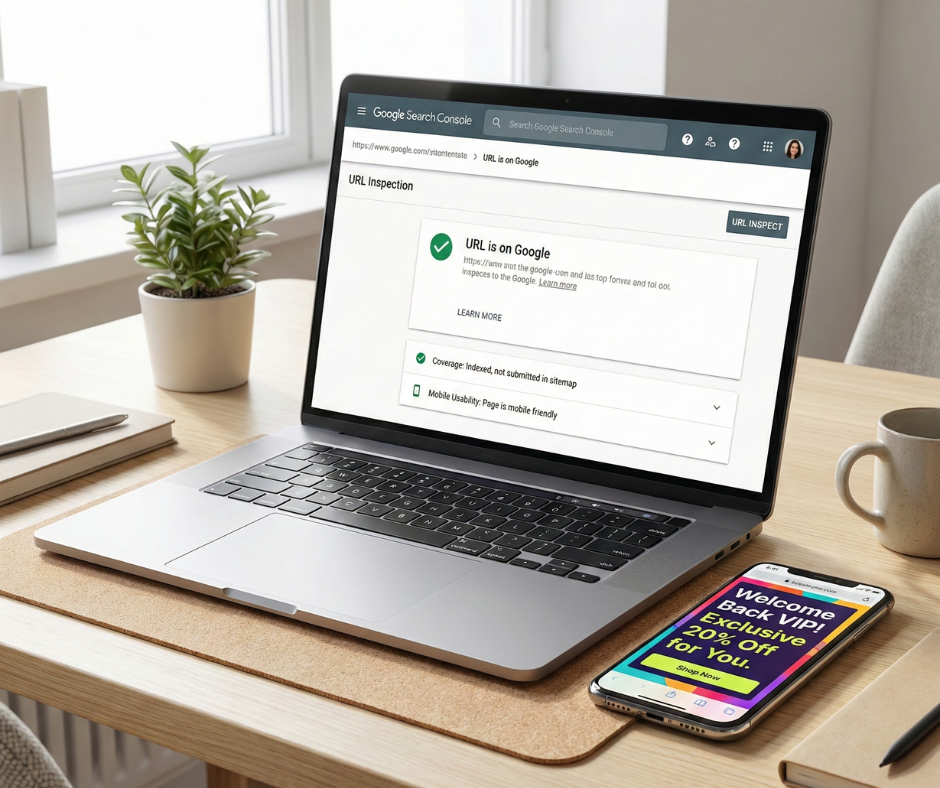
You should never assume your personalization is SEO-safe without empirical testing.
Comparing crawler vs user rendering
Use the “Inspect” tool in your browser to see the source code (Ctrl+U) versus the rendered DOM. The source code is what the bot is most likely to see. If your source code contains the generic SEO baseline but the screen shows a personalized banner, your implementation is likely safe.
Using Google Search Console and URL inspection
The “URL Inspection” tool in Google Search Console is your most valuable diagnostic tool. Enter a URL where a promotion is active and click “Test Live URL.” Look at the “Screenshot” and the “Recieved HTML.” If the screenshot shows your generic baseline and the HTML does not contain user-specific promotional parameters, you have successfully isolated your personalization layer from the search index.
Monitoring indexation and rankings
Keep a close eye on your “Pages” report in Search Console. If you see a sudden spike in “Excluded” pages or “Duplicate, Google chose different canonical than user,” it is a sign that your promotional parameters are leaking into the crawl path. Successful management results in a stable index count even during heavy promotional seasons.
Common Magento personalization mistakes that hurt SEO
Avoiding these common pitfalls will save your store from unnecessary ranking drops:
- Creating multiple indexable versions of the same page: Each segment should not have its own URL key. Use one URL and modify the content via JavaScript.
- Personalizing core SEO elements: Never change the H1 or the Page Title based on a promotion. Keep the H1 as “Men’s Running Shoes” even if the banner says “20% Off for You.”
- Forgetting canonical tags during promotions: If you launch a landing page for a specific email campaign, ensure it doesn’t compete with your main category page for the same keywords.
- Treating personalization as “set and forget”: Digital marketing moves fast. An old promotion rule that is no longer active but still generates “Ghost URLs” can continue to waste crawl budget for years if not audited.
Conclusion
In summary, personalizing Magento promotions without hurting SEO is a strategic necessity for brands that refuse to choose between higher conversions and organic visibility. By prioritizing a disciplined approach to site architecture—moving away from server-side HTML variations and toward a robust, client-side JavaScript delivery model—you protect the integrity of your index.
The final recommendation for Magento store owners is to treat search engine crawlers as a “special segment” that always receives your highest-quality, most consistent baseline content. Use Magento’s native “Private Content” or AJAX logic to load promotional blocks so that the cached page remains pure. By aligning your technical implementation with the principles outlined in this guide, you can scale your personalization efforts with the confidence that your organic foundation remains secure and profitable.