
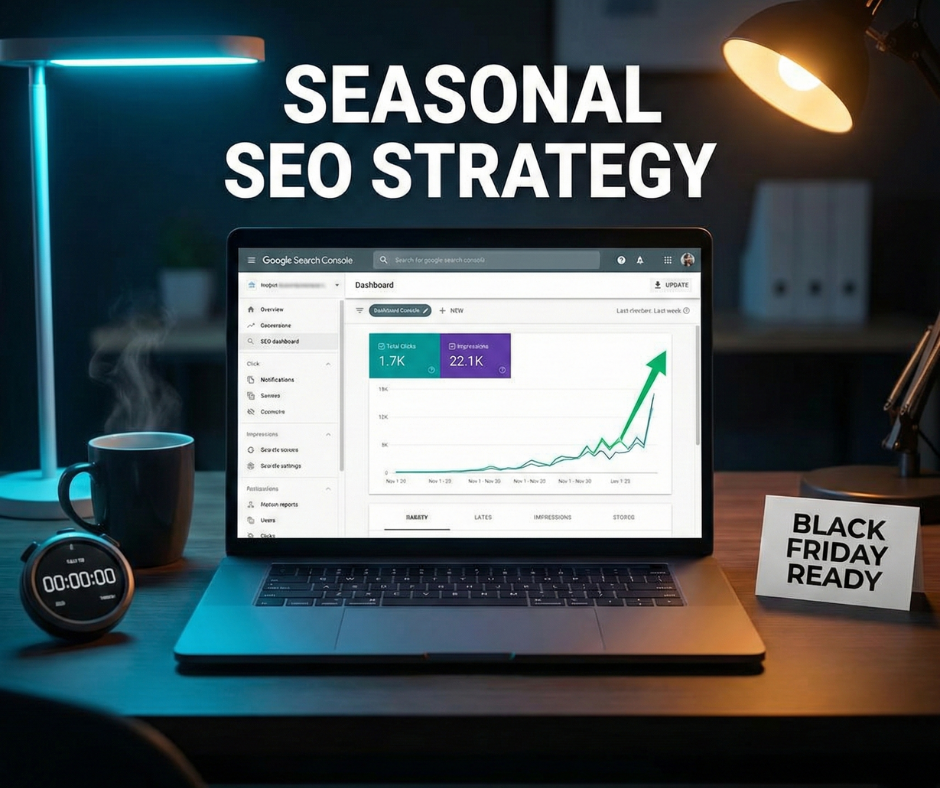
For Magento merchants, seasonal traffic peaks during events like Black Friday or holiday sales represent the year’s greatest revenue opportunity and technical challenge, with search demand often spiking by over 1,000%. However, these surges bring significant SEO risks, including crawl budget waste, performance bottlenecks, and ranking instability, requiring a specialized discipline that aligns technical infrastructure with time-bound search behavior.
This guide provides Magento merchants, SEO specialists, and eCommerce managers with a structured framework to navigate these peaks effectively. We will explore how to identify seasonal opportunities, optimize resilient landing pages, and execute the technical cleanup necessary to transform temporary traffic spikes into long-term SEO assets, ensuring your store remains visible and authoritative during peak demand.
What is seasonal SEO in Magento stores?
Seasonal SEO in an eCommerce context refers to the strategic optimization of a website to capture search traffic related to recurring events, holidays, or specific times of the year. While evergreen Magento SEO focuses on maintaining steady rankings for your core product catalog year-round, seasonal SEO is inherently time-sensitive and characterized by intense, short-lived demand.
The primary difference lies in the queries. Evergreen SEO targets “leather boots,” whereas seasonal SEO targets “Black Friday leather boot deals” or “Christmas gift ideas for hikers.” In Magento, this often involves managing temporary category structures, promotional CMS pages, and a high volume of faceted navigation URLs that exist only for a few weeks.
Common seasonal events include:
- Global retail holidays: Black Friday, Cyber Monday (BFCM), and Prime Day.
- Cultural holidays: Christmas, Lunar New Year, Valentine’s Day, and Mother’s Day.
- Industry cycles: “Back to School” for stationery, “Spring Cleaning” for home goods, or the launch of new fashion seasons. Effectively capturing these shifts is a cornerstone of broader marketing strategies for Magento fashion stores, where staying ahead of trend-driven search queries is essential for maintaining a competitive edge.
Why seasonal SEO preparation is critical for peak traffic
The stakes during peak season are exceptionally high. In many B2C sectors, the revenue generated during the final eight weeks of the year can account for up to 40% of the annual total. Preparation is critical because search engine algorithms do not react instantaneously to new content. If you launch your “Holiday Gift Guide” on December 1st, you have likely already missed the peak research phase performed by early shoppers in November.
Poor preparation leads to several common failures:
- Missed rankings: If pages are not indexed and “warmed up” with internal links weeks in advance, they will not reach the first page in time for the demand peak.
- Crawl waste: Magento’s native architecture is prone to generating millions of URLs via filters. During sales, bots may get stuck crawling discounted filter combinations rather than your primary landing pages.
- Performance issues: Traffic spikes can slow down page load times. If your Core Web Vitals drop during a peak period, Google may temporarily demote your pages in favor of faster competitors.
- Long-term technical debt: If seasonal pages are handled incorrectly—such as deleting them every year—you lose the accumulated link equity and authority, forcing you to start from zero next season.
Step 1. Identifying seasonal opportunities for your Magento store

A successful campaign begins with data, not guesswork. You must understand what your specific audience is searching for and when their interest begins to climb.
Seasonal keyword research for Magento
The first step is analyzing historical data. Use Google Search Console (GSC) to look at your performance from the previous year. Identify which terms drove the most impressions and clicks. This historical baseline is your most valuable asset.
Complement this with Google Trends to identify the “onramp” for seasonal interest. For example, searches for “outdoor Christmas lights” typically begin to rise in mid-October. Mapping these trends allows you to set a content calendar that ensures your Magento pages are live and indexed at least 4 to 6 weeks before the peak.
Finally, distinguish between high-intent seasonal keywords (“buy waterproof winter coats”) and generic research terms (“best winter coat styles”). Your Magento categories should target the buying intent, while your blog or CMS pages target the research intent.
Choosing the right pages to target seasonal demand
In Magento, you have two primary options: reusing existing categories or creating new ones.
- Reusing categories: If you have a “Sale” or “Clearance” category, it is often better to keep the URL consistent year-round (e.g., domain.com/sale) and simply update the products and metadata for each season. This preserves link equity.
- Dedicated landing pages: For massive events like Black Friday, a dedicated URL (e.g., domain.com/black-friday) is standard.
The goal is to avoid keyword cannibalization. Ensure your “Black Friday Shoes” page doesn’t compete with your standard “Shoes” category for general terms. Use specific H1 tags and metadata to signal to Google exactly which page serves the seasonal intent.
Step 2. Building and optimizing seasonal landing pages in Magento
Once the keywords are mapped, you must build the infrastructure to host the content. Magento offers several ways to handle these page types.
Magento page types suitable for seasonal SEO
CMS pages are ideal for “Gift Guides” or promotional hubs. They allow for complex layouts using the Page Builder tool, where you can mix editorial content with product blocks. However, CMS pages lack the native filtering and sorting capabilities of categories.
Category pages are the workhorse of seasonal SEO. By creating a “Holiday Gift Guide” as a Magento category, you allow users to filter by price, brand, or size. You can use Magento’s “Category Products” rules to automatically populate these categories with items marked with a specific attribute (e.g., is_seasonal = yes).
Hybrid structures are often the best approach. Use a CMS page as the high-level “entry point” to provide SEO-rich copy and storytelling, then link directly to specialized sub-categories that handle the product filtering.
On-page SEO best practices for seasonal pages
Standard on-page rules apply but with added urgency.
- Titles and meta descriptions: Include the year (e.g., “Best Tech Gifts of 2025”) to signal freshness.
- Internal linking: Link to your seasonal hub from your homepage and main navigation. This signals to search bots that these pages are currently the most important on the site.
- Content depth: Don’t just list products. Provide value through “Buying Advice,” “Shipping Deadlines,” and “Compatibility Guides.” Google rewards pages that provide comprehensive answers to user queries.
Step 3. Technical SEO preparation for seasonal traffic spikes

Technical stability is the foundation of seasonal success. Magento stores are notoriously complex, and this complexity can become a liability during high-traffic events.
Managing crawl budget during peak seasons
Crawl budget management is the act of ensuring search engines spend their time on your most valuable pages. Magento stores often suffer from “crawl waste” due to faceted navigation. During a sale, you might have filters for “Percent Discount” or “Deal Type.” If these are left open to bots, Google might spend its entire budget crawling ?discount=10-20 instead of your main “Black Friday” landing page.
Prioritize your URLs by using robots.txt to block low-value parameters. Utilizing a professional SEO Magento extension helps manage canonical tags dynamically, ensuring that filtered variations always point back to the “clean” seasonal category.
Indexing and URL management
A common debate is whether to delete seasonal URLs after the event. Never delete a high-performing seasonal URL. If you delete domain.com/black-friday on December 1st, you destroy all the backlinks and authority that page earned.
Instead, keep the page live but in a “hibernation” state. Update the content to say “Our Black Friday 2025 deals have ended. Sign up below to be the first to know about 2026!” This keeps the URL in the index and maintains its authority for the next cycle.
Performance and Core Web Vitals readiness
Google uses page speed and stability (Core Web Vitals) as ranking signals. During peak traffic, server response times often slow down.
- Caching: Ensure Varnish or a similar Full Page Cache (FPC) is correctly configured.
- Image optimization: Use WebP formats and ensure that “hero banners” have explicit dimensions to prevent Cumulative Layout Shift (CLS).
- Mobile performance: Over 60% of seasonal shopping happens on mobile. If your Magento theme is heavy or unoptimized for small screens, your rankings will suffer during the busiest shopping days of the year.
Step 4. Internal linking and navigation for seasonal SEO
Search bots and users need a clear path to your seasonal content.
- Navigation menus: Temporarily add your seasonal hub to the main header. This provides a massive boost in internal link equity to that page.
- Contextual links: If you have an evergreen blog post about “The Best Coffee Makers,” add a link within the text to your “Holiday Coffee Maker Deals” category.
- Home page weight: Use the home page hero section to link to your primary seasonal pages. In Magento, this is easily managed via CMS Blocks.
Step 5. Content and UX optimization during peak season
SEO doesn’t stop at attracting the click; it includes the experience after the click. If users land on your page and immediately bounce because information is missing, your rankings will eventually drop. Beyond just retaining visitors, peak traffic periods offer the perfect environment to execute upsell and cross-sell campaigns in Magento, encouraging shoppers to add complementary items to their seasonal haul.
Align your SEO content with your actual promotions. If your meta description promises “50% off,” that offer should be immediately visible on the landing page. Furthermore, provide clear messaging regarding stock availability and shipping deadlines. B2B and B2C buyers alike are driven by deadlines during the holidays. Providing this information directly on the landing page reduces anxiety and improves engagement signals, which indirectly supports SEO.
Monitoring SEO performance during the season
During the peak, you must monitor your metrics daily.
- Impressions and rankings: Use GSC to track if your seasonal terms are gaining traction.
- Crawl stats: Check the GSC “Crawl Stats” report to ensure Googlebot isn’t getting stuck on 404s or redirect loops.
- Real-time adjustments: If you notice a specific product is trending but isn’t ranking well, increase the number of internal links pointing to that product from your seasonal landing pages.
Post-season SEO cleanup and long-term strategy
The “Cleanup” phase is what separates amateur merchants from professional SEOs.
What to do with seasonal pages after the peak
Once the sale ends, you have three main paths for your URLs:
- The “Hibernation” path (Recommended): Keep the URL live but update the content for the “off-season.” This preserves all link equity and authority.
- The “Redirect” path: If the page is truly redundant, 301 redirect it to the most relevant evergreen category. For example, redirect domain.com/christmas-deals to domain.com/sale.
- The “Noindex” path: Keep the page live for users who might have bookmarked it, but use a noindex tag to prevent it from appearing in search results during the off-season.
Learning from seasonal data
After the rush, perform a post-mortem. Which keywords over-performed? Which technical issues occurred? Use these insights to refine your keyword targeting and page structure for the next peak. Success in seasonal SEO in Magento stores is a cumulative process; each year should build upon the authority and data gathered in the previous year.
Conclusion
Preparing for peak traffic in Magento is a multi-month endeavor that requires a disciplined approach to both content and technical SEO. By treating seasonal SEO in Magento stores as a recurring cycle rather than a one-time project, you can turn temporary demand spikes into permanent ranking gains.
The recap of the seasonal SEO preparation framework is simple: research early, build resilient landing pages, protect your technical performance, and maintain your URLs long after the sale is over. Early planning is the absolute key to winning the battle for visibility during peak traffic. When you treat search bots with the same respect as your customers—by providing them with fast, clear, and relevant paths to your products—you ensure your Magento store thrives in the most competitive retail environments on earth.